Indefensible Defending
Defending is hard, I know this because I’m terrible at it. But I’m not here to talk about my own failings, I’m here to talk about how clever I am defending.
The Mind Of The Novice
I used to coach a women’s team at work and it’s very different from coaching boys or men because some of them really are starting from absolute zero. They don’t watch football games and haven’t played before. One lady’s first steps were to do some technical work (with a female semi-pro player) and then played in a game. Afterwards she told me she found it quite frustrating and wanted to know how she could take the ball off the opposition players. Before we get carried away with commentary on this, I want to pause and consider her mental model of how defending works:
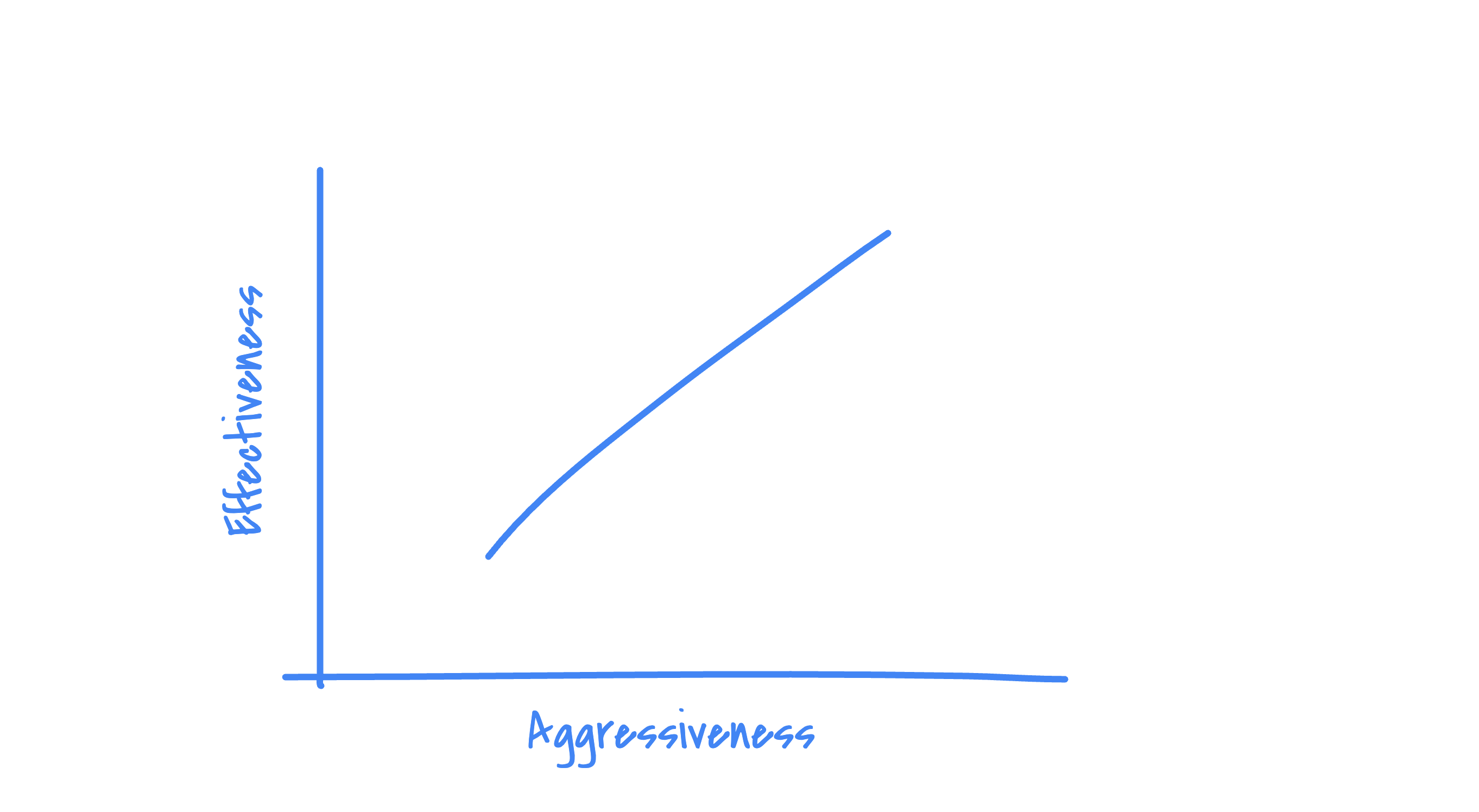
The graph above represents the novice’s concept of defending: specifically that there is some technique or process to getting the ball off the opposition, and logically speaking the effectiveness of this is going to be determined by how vigorously (or aggressively) you execute it.
The perspective of a rank beginner is illuminating because it was a very long time since I was one, and it is surprising to me that other people don’t have the same understanding as I do. Not with regards to facts, you are either exposed to a fact or you aren’t, but with things that can be observed. If I can observe something, surely everyone can make the same observation.
Moving along to junior football, where I have some experience, you are working with a mixture of boys who just like to play and boys who are immersed in football. Some of them play in the school yard, go to games with their parents and spend the rest of their spare time playing FIFA in their bedrooms.
Even still, in junior football, a similar attitude prevails: the parents tend to shout “stick your foot in!” (attempt a tackle) and encourage active participation. And the kids themselves are there to play football, to get involved in the game and influence it. All this is in a sense, exactly as it should be, and the style I wanted to play with my boys was a proactive style. Few boys are motivated to get out of bed on a freezing Sunday just to spend 90 minutes jockeying opponents.
At the risk of showing my age I must of course make reference to the legendary Paolo Maldini who is purported to have made little more than one tackle every two games. There are lots of rewarding challenges in junior football and I wish you the very best of luck trying to sell kids on being the new Maldini.
The Mind Of The Expert
At the more experienced end of the spectrum, you have the professional football player. They aren’t Maldini either but they are very careful not to get beaten by dribbles and I read somewhere that the successful tackle percentage of a professional footballer is something like 80%. The only way you can get that kind of success rate is to be very picky about when you attempt to make a tackle.
Defending in the mind of the expert/experienced footballer, is very different.
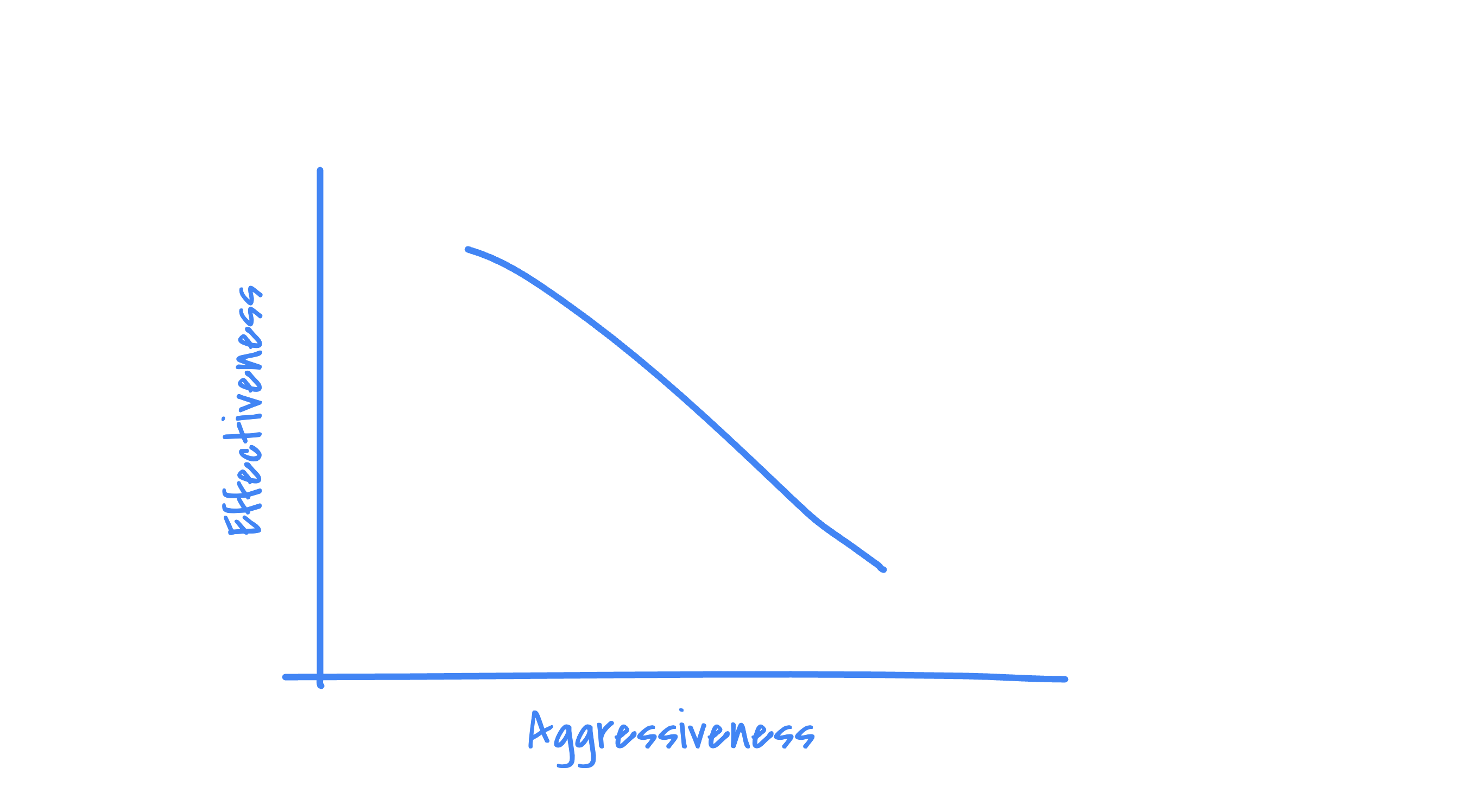
The professional footballer has had years of coaching to get them to understand that cautious and conservative defending is the best way to do it. The further they go in their career, the more the message will have been reinforced by the painful experience of facing opponents that are more and more able to punish them for making a mistake. This is genuine expertise informed by frequent contact with reality. Uncontroversially, the pro is right and the beginner is wrong.
There’s another level beyond just the experienced or professional footballer: the same the professional footballer in a team that is ahead in a game and desperately wants to defend their lead. Now the player doesn’t just want to defend as effectively as normal, no, he is desperate to defend very effectively.
All his life he has been coached to defend passively rather than aggressively, so the player imagines the answer is to be even more careful, more cautious and less aggressive in defending, as represented in the graph below.
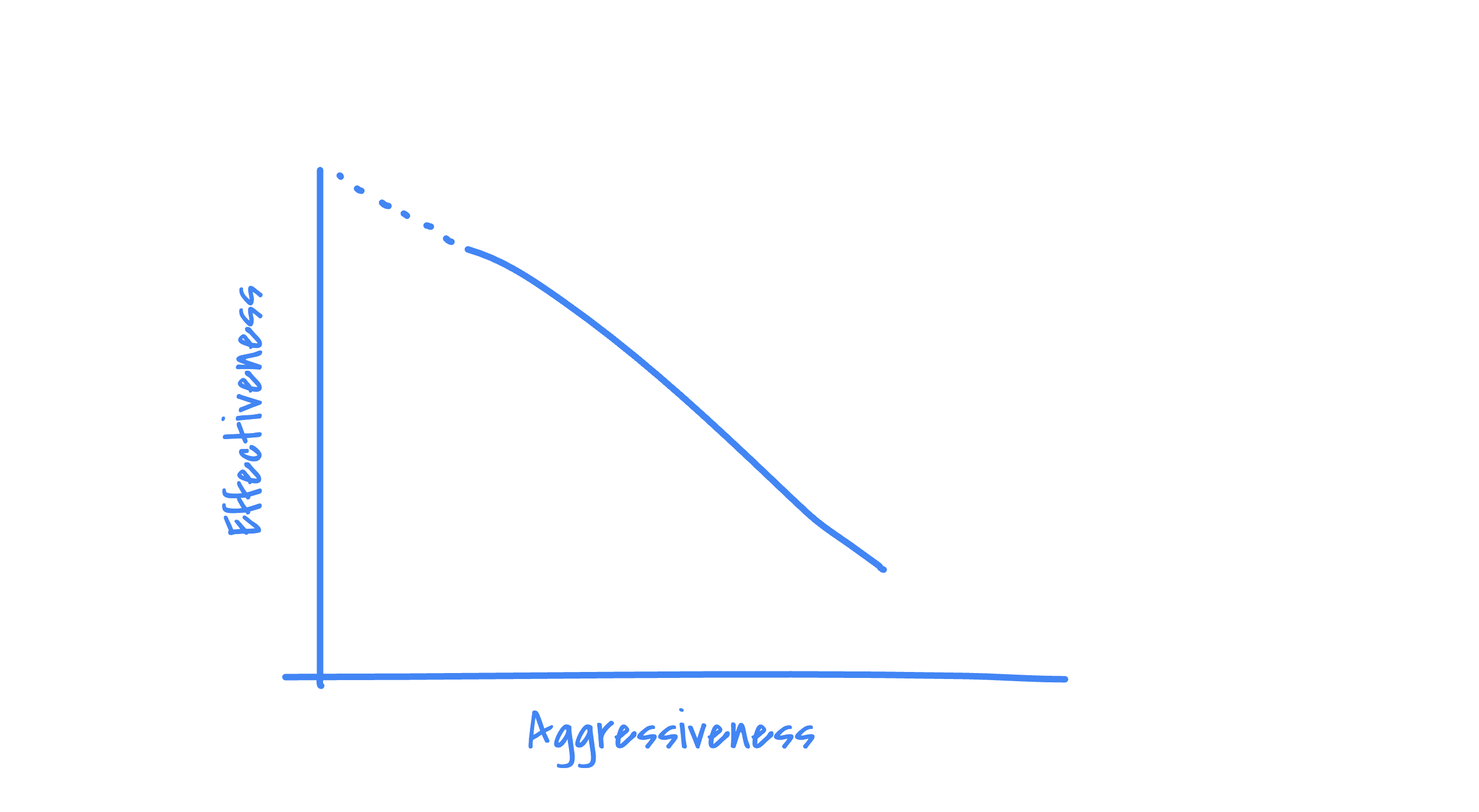
However, it doesn’t seem to work like that to me. Countless times I have seen teams dominate games, they’ve had the lion’s share of the possession, pressure, attacks, shots and goals. Because they are leading, teams think they don’t need those things any more, rather, what they need to do is defend resolutely what they have. And because there’s no need to attack normal constraints on how passively they defend aren’t there.
I will follow this post up with quantitative analysis but anecdotally, this approach seems to be catastrophic. It plays out like this: since there’s no willingness to engage the ball in the opponent’s build up, the opponent accesses the final third effortlessly. There’s little pressure on the ball and therefore the opponent is able to comfortably deliver the ball into the penalty box. Clearances just return the ball to the opposition because nobody is in position to contest a clearance. The immediate pressure is released by a clearance but it buys very little time before the ball arrives in the box again. The opponents don’t need to worry about defending so much and can throw people forward, and the ball continues to be delivered into a crowded box over and over again.
Sure, in theory, the leading team can defend a few crosses. In practice, nobody is perfect and someone will make a mistake sooner or later. The plan boils down to: if everyone plays perfectly then we will win the game. It seems an absurd hope to flawlessly defy wave after wave of pressure, but that’s what teams apparently decide to do. Very often the plan fails, a mistake or a lucky bounce results in a goal and the cherished lead is no more.
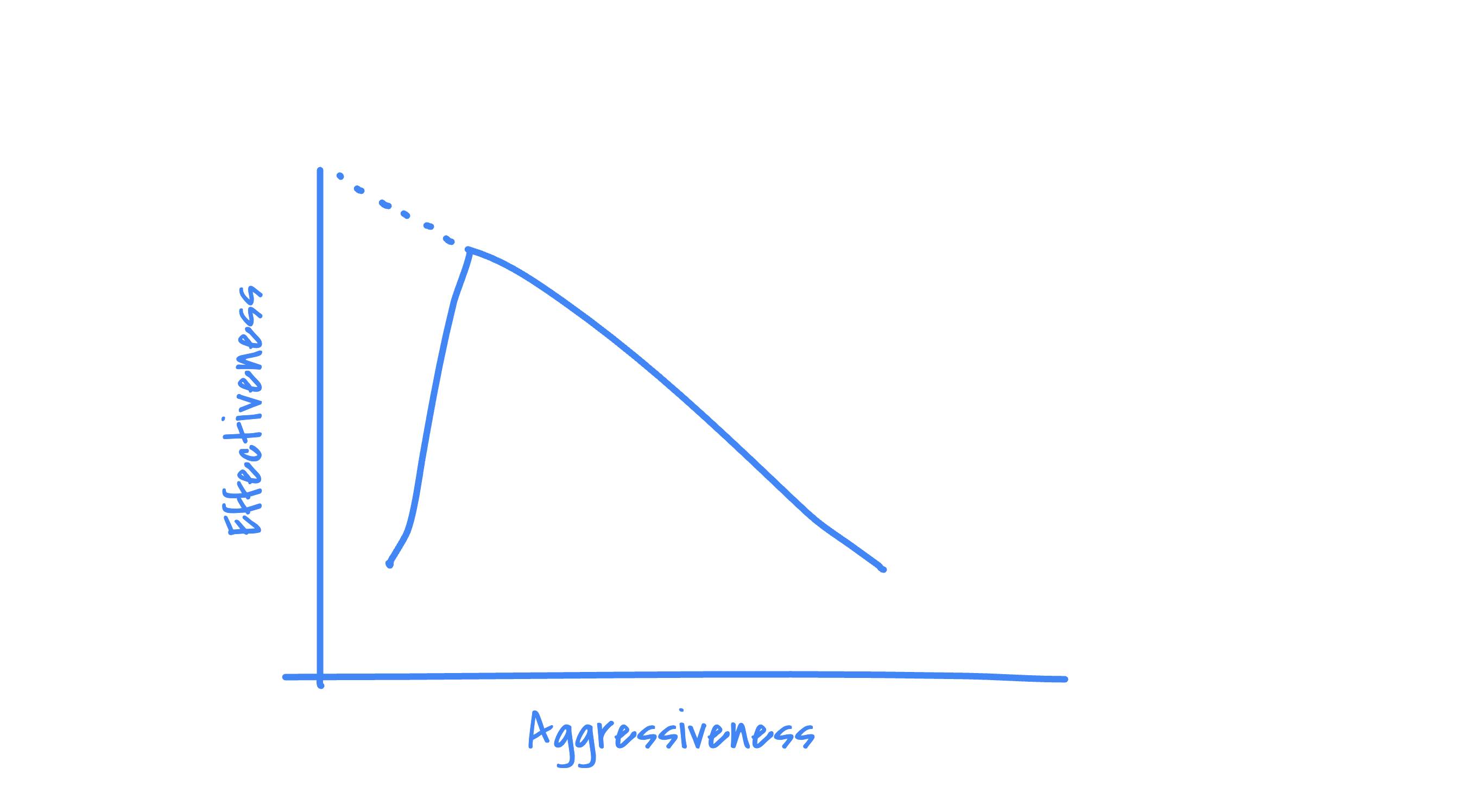
I think defensive effectiveness on my graph is more like a “U-shaped curve” rather than the simple linear relationship with aggressiveness (or vigourousness if you prefer) that it appears to the expert. My graph is drawn the way it is to make the axis labelling easier to understand, but ideally, I would have drawn the y-axis inverted so that when I claim the graph is a U-shaped curve, it would be immediately apparent that it is a U-shape. To do that I would have had to label the y-axis “Ineffectiveness” and it would be quite strange – the graph would be of defensive ineffectiveness rather than effectiveness and maximum effectiveness would be at the x-axis.
Such U-shaped curves appear in life and the unintuitive nature of such dynamics has helped fill many a fine popular economics book and also “Doughnut Economics” by Katie Raworth which is dreadful. Just for example of such curves, the amount of water you should drink per day is a U-shaped curve, too little and you will die obviously and too much will also be terminal. You need sunlight for vitamin D but too much will result in melanomas. The amount of pocket money you give your children is the same, too little and they won’t be able to learn from interacting in a market economy, too much and they won’t care about the cost or value of what they buy.
There’s lots of U-shaped curves in life, and that the dynamics of defending are like the dynamics of lots of other things in the world makes seems, in my unbiased opinion, like another reason to buy my theory.