Neutral Trade Offs
Neutral trade-offs in football
Imagine you were managing a football club, and you hired an Italian specialist coach to help you defend. It’s a thought-experiment so please try to entertain the possibility. Shockingly, the main recommendation of your new coach, Antonio Puliso, is that you should simply time-waste as much as possible. He says: “It’s a completely neutral trade-off, you spend less time defending and less time attacking. Defending is a problem for you so this is a way of doing less of it”.
Intuitively this sounds right, there’s just going to be less football, you’ll attack less but crucially other teams will attack you less as well. Neat.
This sounds like, what I’m going to call a “neutral” tactic, which is to say, one that is beneficial and detrimental in equal amounts.
Reflecting more on the advice of this Puliso guy, it occurs to you that this isn’t a neutral effect. If your team is one of the better teams in the league then the longer the game goes on and the more football is played, the more likely it is that your team will be able to convert its superiority in to goals and wins. Time-wasting is a bad tactic in those circumstances. Similarly, if your team was one of the less capable sides in the league then this is a good tactic, it will be harder for your superior opponents to score goals and beat your team.
Is there is no such thing as a neutral tactic in football? I can’t think of one right now.
But wait, there’s more. There’s more because everything I’ve written so far is just a mixture of lede-burying and scene-setting for what I really want to write about.

There is a tactic in the world of football commonly thought to be agreeable or at worst, neutral. It is simple, and defensively strong based on an ability to cover all the spaces. But to gain this outcome, it sacrifices a lot of freedom in attack. It is the Four-Four-Two (henceforth “442”) formation.
The first thing to say is that 442 is not intrinsically bad or wrong. It has strengths and weakness just like any other approach. My problem with it is that what it is good at, I don’t value very highly and conversely what it is bad at are things that I do value highly.
I don’t think swapping attacking capabilities for defensive robustness is a neutral trade off, and you probably guessed that I don’t think it is a positive trade-off either.
Attack vs Defence
If you accept that you could, in theory, trade off attacking potential for defensive robustness, then it seems like a reasonable thing to want to do, right? Well, I think the mistake people make is that it is tempting to think of attacking and defending as two distinct and logical opposites of each other. If you define defending as protecting the goal from your opponent’s attacks then, yes, defending is very different from attacking. But if you define defending as “things that the team does to stop the opponent from scoring” then one of the things the team might do is execute an attack of its own or retain possession of the ball. This seems like a perfectly reasonable definition, and as per the popular aphorism, it’s easy to imagine that attack is indeed the best form of defense. When I was managing a junior football team I often considered what I should work on in the small amount of time I had with my junior football players. If I worked on defending we might concede fewer goals, and if I worked on attacking we might score more goals. The thing is that if we worked on attacking then we should do more of that and less defending, we would spend less time defending, make fewer mistakes and concede fewer goals.
Trading off defensive robustness for attacking gains
For comparison, in my 433 I had two central midfielders and one defensive midfielder. My centre-forward was more of a false nine dropping deeper to receive the ball. What this meant was my team had very good control of the ball in the centre of the pitch, and the defensive midfielder was always there to snuff out any counter-attacks if the midfielders where caught in the dribble or if they misplaced a pass. In exchange for this we have much less control of the sides of the pitch. The upshot of this trade-off is that we will have more of the ball in the middle and our opponents would have more of the ball at the sides. And, yes, my full backs would be potentially a little bit exposed. That was a concession, no doubt, but we also got very easy progression to the wide attackers, and also a shape where midfielders always had a progressive pass available to their left and to their right. All things considered, I gave up things I didn’t value so much – defensive control of the sides of the pitch, in order to get things I did value, protection from counter-attacks and easy progression. One way to think of it is that I am increasing my team’s ability to score and in turn increasing the opponent’s ability to score as well. It’s not as pointless as it sounds, I think I am gaining a bigger increase in my team’s attacking chances than we are increasing the opponent’s attacking chances. More goals will get scored but hopefully a greater share of them will be scored by my team.
Now, 442 does not accept that trade off. It does not trade off any defensive robustness or control for easy attacking. In fact, if anything it gives up some attacking ability to gain its considerable defensive strength. 442 has every base covered, there are no holes, spaces or weaknesses defensively. There is a reason why professional teams will drop back to defend in a compact 442 shape. It’s very formidable defensively and hard to exploit. Where I would be willing to concede a goal if my team could score a goal and a half with my 433, managers who choose 442 don’t want to give up any goals and its not a deal-breaker for them that such a setup hinders their team’s scoring chances. There will be fewer goals and I think 442 teams are as a rule less attacking and less entertaining to watch.
This is another key reason why I find the trade-off 442 makes undesirable – it is more robust but is it more robust than spending less time defending?
Flexiblity
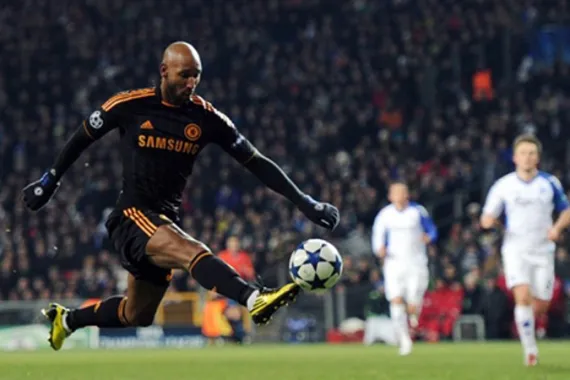
The next sad thing about 442 is that the defensive robustness is based on having all the spaces covered. If, when attacking, the players make runs that take them out of their positional area, then gaps appear and the defensive robustness is lost. This forces it be a very rigid system. In contrast, my 433 has three midfielders so if one makes a run away from his position, there is no particular gap created behind him, the situation just becomes one where we would have had a lot of control over the centre of the pitch, now my team has less control there but not to the point where there are large gaps or new weaknesses. It doesn’t fatally weaken the defensive control. We still have some control of the centre and less control at the sides. I have a few fixed points that really need to have some discipline, the wide attackers and the defensive midfielder but the other attacking players have some considerable freedom. 442 has very little attacking flexibility. Almost all the dynamism and flexibility has to provided by the second striker (or in modern parlance, number ten). The ability of this one single player is absolutely critical to attacking success of the 442. It’s fine if you have Nicolas Anelka playing for you, but big surprise, Anelka is not playing for your junior football team. To be a good number ten in this system you need to be very skilful, very game savvy and dynamic, at the level I coach at, nobody has the in-game intelligence, dynamism and skill to be nipping into tight spaces and linking the attack and the midfield.
To be completely fair, I should mention that the FBs in a 442 also offer some amount of positional flexibility – they can get forward, overlap and cross the ball in the final stages of the attack. I have two counter-points, the first is that the positional flexibility of FBs in attacking only really happens when an attack is well underway. There is no positional flexibility from FBs in the build-up (the early phases of an attack) because the FBs cannot risk getting caught out of position if possession if the ball is gained by the opponent. There is some flexibility here but it doesn’t help get attacks going, it only helps when attacks are already going. Also, I cannot really consider this to be a point heavily in favour of 442 since this semi-flexibility of FBs exists in any system you might choose that has a back four.
Pressing
At the level I coach at, pressure on the ball is richly rewarded. An easy way to force the opponents to cough the ball up, and relatively easy to coach – you are coaching a mindset rather than any particular technique and the kids can see the benefits clearly. Yet another thing that frustrates me when we play 442 is that your team just doesn’t have easy access to the ball: by this I mean, you can’t surround the opposition and get players on top of the ball and force them to give up possession. All the top teams I watch on TV somehow manage to get a lot of players around the ball, force a turnover and retain possession. This is what we are in effect practising when we play rondos in training, and we do that a lot. It’s of little use to a team playing 442, where the point is to cover the spaces evenly rather than committing to contesting the ball in one part of the pitch.
Pitch control
Where my 433 gives up some control at the sides of the pitch, it gains more control over the centre of the pitch. Again, 442 doesn’t go for that trade-off. It doesn’t want to give up spaces anywhere, which is fine but the flip side of the coin is that it doesn’t really project control anywhere either. On a similar point, 442 is three flat lines and doesn’t offer any depth. If you think of attacking as trying to peel the layers of the opponent away, then 442 has just 3 layers, whereas my 433 has 5: Wide-attackers, False-9, Centre Mids, Defensive Mid, Defence. Because of the few vertical layers, there can be gaps between the defence and the midfield that the opponent could exploit. The way you deal with this using a 442 is that you try to compress the space between the 3 lines of players so there is not enough room for the opposition team to try to receive passes there. This means the forwards have to come back, the midfielders have to drop deep and probably the defence will try to have a high line to avoid completely retreating and handing control of the pitch to the opposition.
Progression
Football is an invasion game, to succeed your team needs to be able to move the ball downfield, invading the opponent’s territory. How does the typical 442 team move from defense to attack?
All the midfielders in a 442 are filling gaps and tracking runs and helping to defend. The wide midfielders have to get back and help the full backs out. When a 442 team wins the ball and looks to start an attack, the options are extremely limited, there are two players in front of the ball at most. Typically the ball is played forwards to the number 9, who will be man-marked or even double teamed, he will have his back to the opponent’s goal and it will his job to control the long ball and physically defend possession until such time as the rest of the team can get up the pitch to support him. For this to work the number 9 needs to a be a big, strong player. Sadly for the junior football team I currently coach, such attributes are sorely lacking. Even for teams that do, it’s very low percentage football, booting the ball forwards and fighting to establish possession while the rest of team advances to help.
“Negative” Progression
Symptomatic of the difficulty in progressing the ball in a 442 is a very distinctive pattern of play. It starts with the ball being played forward to an attacker, who (hooray!) succeeds in holding off the opponents and retaining possession. From this precarious foothold the attacker is able to play a pass to a team mate. Almost all his team-mates are not as far advanced up the pitch as he is, so the pass is backwards. The receiving player comes under pressure and looks for a pass, which at best is sideways and more likely is backwards again. Since all the players who have touched the ball have attracted pressure and are now marked or covered by the opposition team, the ball cannot be played forward to them. So, the next pass is sideways or backwards. This continues with the ball eventually at the feet of the defenders who have no easy forward passes available and the ball is returned to the goalkeeper who kicks it long with the hope that the ball can be won and protected and the sequence can be restarted. It may be that someone who chooses 442 is OK with this but to me it just looks a lot like failing. The fact that you have a setup that struggles to gain any kind of ball progression, makes me think it is just a bad system.
Positional Play
Is positional play just a load of snake oil? Attend my online seminar to find out! Well, probably it is snake oil but the positional play maxim of of “no more than one player on a line” makes perfect sense. As soon you have multiple players in the same passing lane the passing options are significantly reduced. In a five a side game, you have four outfield players and a maximum of three passes when you have the ball at your feet. Should two of your team mates be in a line, then now you have just two available passes, you’ve lost a third of your options. Worse still, the ball is “trapped” by your nearest player and evading pressure by moving the ball a long way is not an option. Well 442 makes you defend in that kind of flat, everyone in a line, type of structure. When you win the ball back it’s very hard to retain possession partly for this reason.
Qualitative measures
I had an idea that I should be able to demonstrate the clear terribleness of 442 by looking at professional clubs and seeing the data confirm what I already thought. It’s not quite so simple, both to collect the data and analyse it. To collect it, I went to whoscored.com and copied the formation information out along with a number of shots taken from in the six yard box, in the penalty area and outside the penalty area. I needed a simple xG model as a way of ranking the level of success or failure each team and formation achieved. I went with a simple approximation of the data presented here. Don’t take xG models too seriously, but add some extra scepticism for my xG numbers here, they are very approximate and probably slightly on the over-optimistic side just for simplicity’s sake.
In the Premier League, the data seems to be warped by the fact that not many teams play 442. Liverpool under Klopp, Manchester City under Guardiola, and Bournemouth under Iraola; each play 442 on occasion and have considerable attacking success, just as they do when they play other formations. I’m not sure that this alters my theory. Newcastle and Everton both have some surprising success with 442. Everton probably get lots of efforts in the six yard box thanks to the ability of Calvert-Lewin. Newcastle, I think, were in the midst of surprising opponents with quite a direct, high tempo progressive style.
I’m cherry picking the data somewhat, but if you look at the 2023/24 year of the Championship then there are more teams trying 442 and more data to draw on. Few teams get above 1.4xG with 442. The majority of teams are getting 0.8-1.4xG with 442 and experience much more attacking success with different set-ups. Five teams have the least attacking threat when they play 442: Coventry, Norwich, Preston, Sheffield Wednesday and Sunderland. Amongst the formations fielded by Bristol City, Southampton and Swansea, 442 carries the second least attacking threat and in both cases only the even more defensive 532 setup has less threat. For Rotherham, 442 is the third least attacking threat ahead of 541 and 451 formations. Further fuel for my argument is that the two teams promoted from the division that season, Ipswich and Leicester, did not play 442 at all. But lets not pretend it is some kind of kryptonite – also rans Plymouth, QPR and Watford also did not play 442.
To summarise, of the 24 teams in the Championship, five did not play 442. Of the 19 that did, five teams found it the least effective attacking set up (26%) and four clubs found it worse behind more obviously defensive set ups (21%). Of the remaining 10 teams, Blackburn, Middlesboro’, Stoke and WBA all created considerably more (almost 0.4xG per game) threat with other systems. Of the remaining six teams, Cardiff, Hull, Leeds and Millwall had other systems that were marginally better, although to be completely fair my xG model is so half-assed that it’s hard to say for sure if they were marginally better in reality. What of the two teams who could make the most threats from 442? Birmingham and Huddersfield were both relegated.
Ease of use
I suppose you have to at least credit 442 with being simple and easy to explain. The roles are clear. Of course, because I dislike it, I have to say that it will cause no surprise to your opposition who will have seen it many times before. Why not challenge your players, yourself and the opposition with something a little more complex?
One final snark
My last dig at 442 is that it just goes to show how brain-dead most football coverage is in the UK that when someone wanted to start up a football magazine with the aim of ascending beyond the “Was it a penalty?” poundshop punditry and “Q: What’s your favourite Cheese? A: Melted” style of journalism, what was the most sophisticated footballing system they could think of? 442.
Recap
My beef with 442 falls into a few categories.
It gives up an ability to attack for an ability to defend. That only seems like it might be acceptable deal if attacking and defending are fundamentally separate, but they aren’t – attacking is a form of defending. It’s a bad trade-off.
I think 442 results in fewer goals and less attacking from either team, therefore I think it makes games objectively less entertaining. I would much rather teams identified some strengths and played to them, with the result that games have two teams with asymmetric plans and set-ups. I was reminded of this watching Chelsea vs Liverpool recently, Liverpool left Salah high without any defensive responsibilities and Chelsea were deliberately targeting Liverpool’s weaker left side to attack. It was gripping to watch, to a degree that many football matches rarely manage.
You can’t easily pressure the ball in a 442, which is bad because, from the perspective of junior football, pressing is very appealing – it’s reasonably easy to coach and provides very significant benefits if it is done well.
It’s a struggle to progress the ball with 442. Football is an invasion game, and yet 442 makes that invasion harder than it could be. In my personal opinion, football played well is very entertaining, football played badly is not. When the team I support play 442 it makes them look bad and they entertain me less. When I watch as a neutral, the game is diminished when one team deploys 442 because both teams attacking abilities are reduced.
There is very little flexibility in a 442, there is one position, the second striker who has all the flexibility. It’s a huge responsibility and it requires extremely good players to do it well.
442 doesn’t project any control over the pitch, it tries to contest control of spaces but it does not try to impose control on spaces. In this sense, the team playing 442 is more of an antagonist than protagonist. My philosophy is that you should try to be the protagonist, and try to shape the game to go how you want it to go rather than try to stop the opposition getting the game to go how they want. One of the advantages you have in football is that opposition probably won’t be familiar with what you are trying to do, you have a ready made advantage right there, why abandon that advantage by playing in a way they have seen many times before?
Working from first principles, I have argued here that there are many shortcomings and sacrifices in playing 442. Ones that don’t fully compensate for, in my opinion, the defensive robustness it offers. I have tried to underline my claims with data, which is unsurprisingly inconclusive, but it points in the direction my complaints would imply.